 Copy URL to Clipboard
Cargo war risk insurance is a specialized form of insurance that covers specified losses or damage caused by war-related events. This can include armed conflict, military hostilities, capture, seizure, and abandoned weapons of war. Standard marine cargo insurance commonly excludes war-related damage, making separate war risk coverage important for shipments exposed to conflict. The protection available depends on the insurance policy, shipping route, and covered perils.
Cargo war risk insurance covers freight that’s damaged or lost due to war or other related events. The following table outlines the events this form of coverage can protect your shipments from.
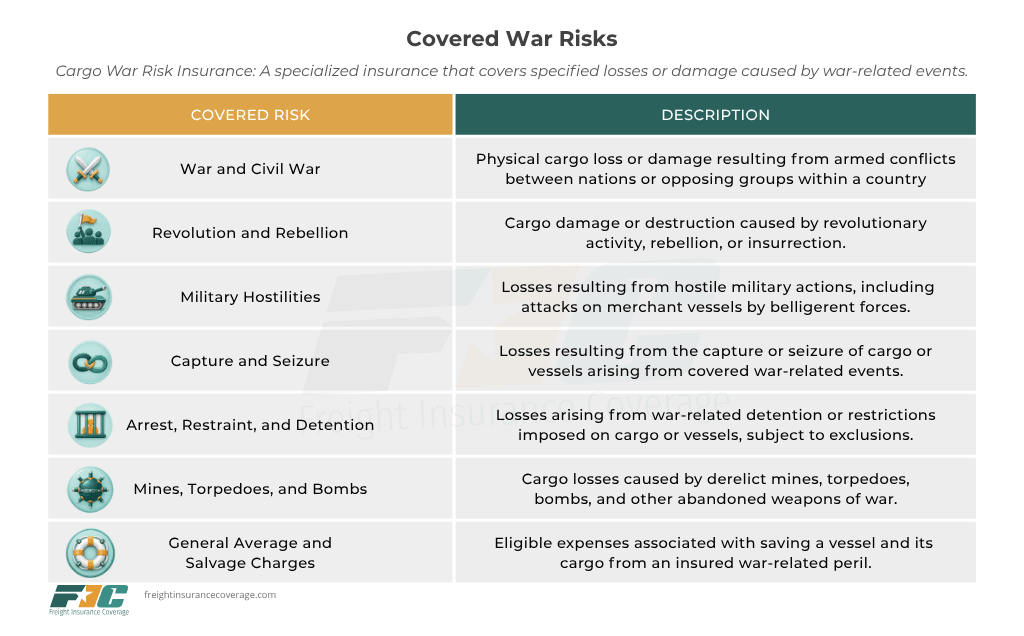
Acts of piracy and terrorism may or may not be included depending on the specifics of the policy. Some insurers offer policies that cover these risks, while others require a separate endorsement before providing this level of protection.
Here are some scenarios covered by war risk insurance:
While most ocean waters aren’t afflicted by war or conflict, certain regional seas are dangerous for freight to travel. Owners of ocean cargo should always know what waters and routes their shipment will travel through to determine what risks they might face.
Cargo war risk insurance can protect shippers from many dangers, but there are certain exclusions that owners of ocean freight should know. The following table outlines common exclusions.
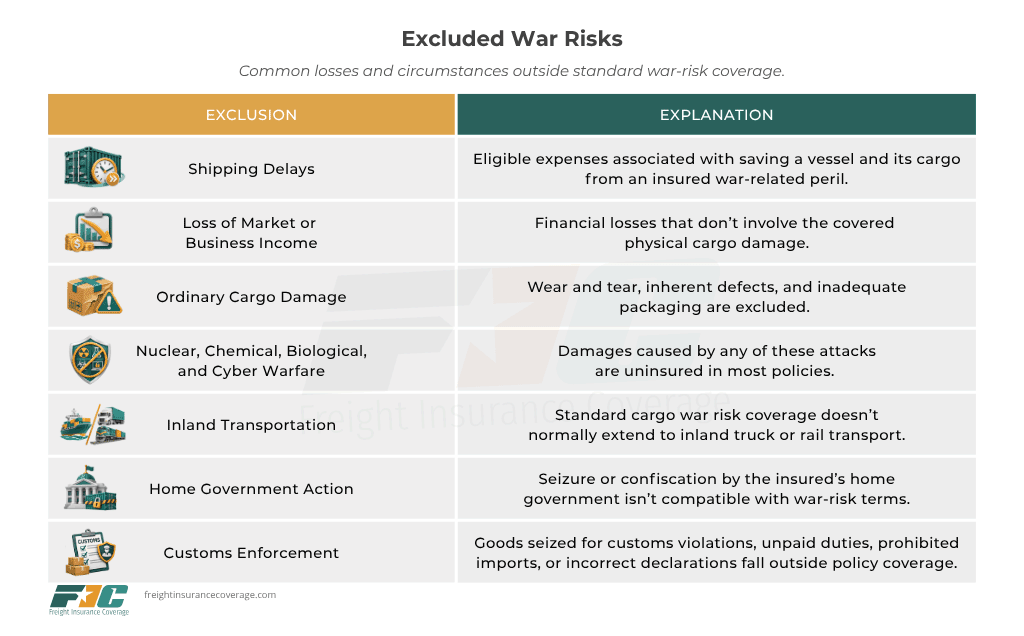
Understanding exactly what war risk insurance doesn’t cover is essential to identifying gaps in coverage.
While cargo war risk insurance protects against war-related perils, marine cargo insurance protects against losses caused by common transportation hazards.
This includes:
The two policies also differ in coverage duration. Cargo war risk insurance coverage usually starts when freight is loaded on an overseas vessel and ends when the freight is discharged at the final port. Marine cargo insurance can be extended to provide warehouse-to-warehouse protection, which includes inland transportation.
Finally, war risk and marine cargo insurance are purchased differently. Marine cargo insurance is the primary policy that shippers will use to cover their freight. Cargo war risk insurance is usually supplementary protection that’s purchased alongside a general policy.
To show these policies in action, consider an American importer transporting $200,000 worth of electronics aboard an ocean vessel.
While cargo war risk insurance and marine cargo insurance have important differences, the two types of coverage complement each other.
There are numerous bodies of water that are dangerous for ocean shipments to travel through, such as:
The UK Maritime Trade Operations (UKMTO), which is an organization sponsored by the British Royal Navy, has collected statistics on maritime incidents in the Strait of Hormuz, the Red Sea, and surrounding bodies of water between February 28, 2026 and November 4, 2026. The following figures illustrate the security threats affecting shipping in these regions.
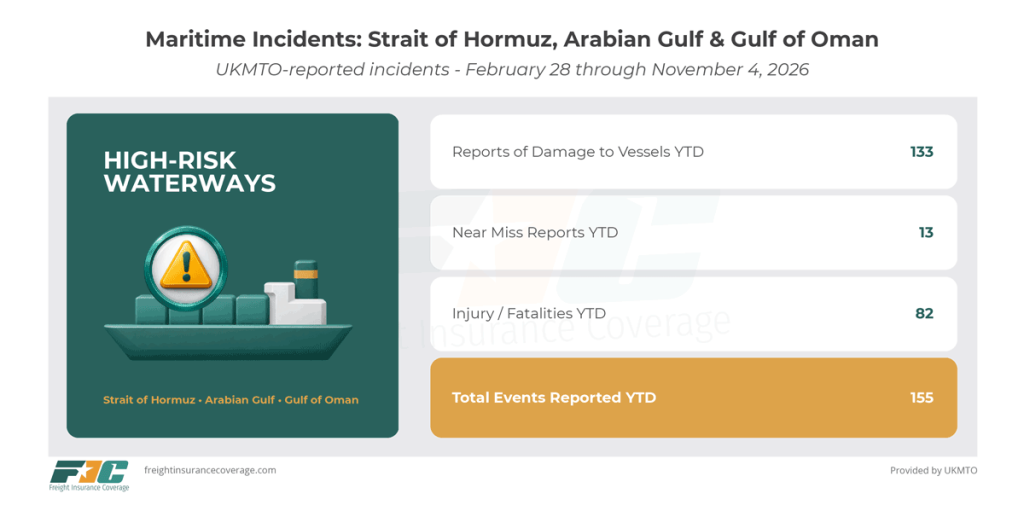
The maritime dangers within these bodies of water are largely driven by military and geopolitical conflicts involving Iran, the United States, and Israel. There are numerous kinetic and explosive threats that can damage ocean freight, such as naval mines and projectile and drone strikes.
Here are maritime incidents that occurred in the Red Sea and a nearby body of water, the Gulf of Aden.
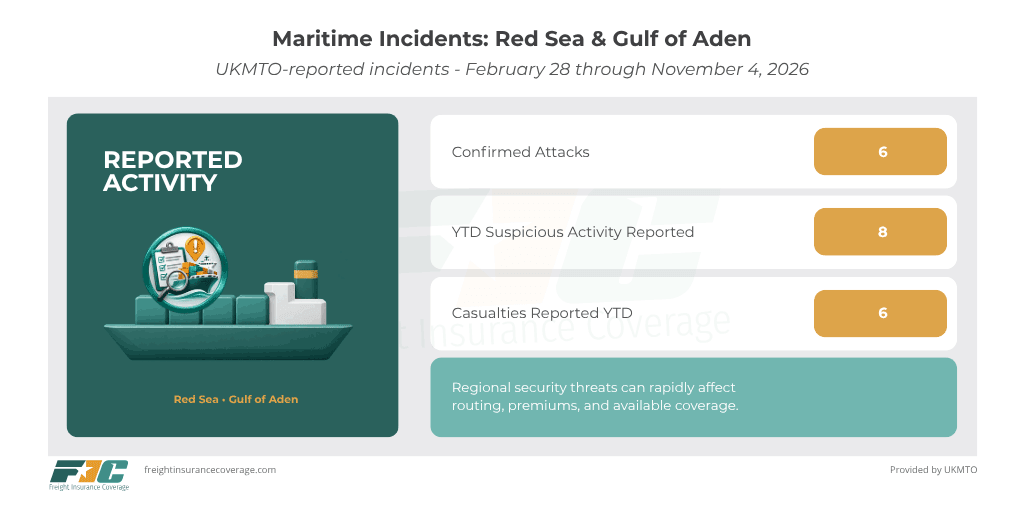
Provided by UKMTO
Dangers and these bodies of water are largely from Houthi militant attacks and resurging Somali piracy.
The Black Sea has become an extremely dangerous body of water for merchant vessels due to the conflict between Russia and Ukraine. Threats such as sea drones, aerial drones, missiles, and floating mines all pose a risk to commercial cargo. According to GMK Center, a Ukrainian consulting company and analytical think tank, over 570 vessels have been struck in the Black Sea. This has resulted in the deaths of at least 40 sailors.
Although piracy is a problem in the Singapore Strait, incidents have fallen sharply in the first nine months of 2026. There were only 13 incidents of piracy between January and September 2026, compared with 73 incidents during the same period in 2025.
Similarly, incidents of piracy in the Gulf of Guinea have declined sharply. Only two incidents of piracy were reported between January and September 2026.
Local authorities are largely to thank for the reduced incidents of piracy in both the Gulf of Guinea and Singapore Strait, but shippers of international ocean freight should still seek out war risk insurance coverage if their freight will travel through these waters.
According to ReCAPP, 50 incidents of piracy were reported across Asia from January through September 2026, a 58% decrease from 120 incidents during the same time period in 2025. Of the 23 incidents recorded in the combined Straits of Malacca and Singapore, one occurred in the Malacca Strait and 22 occurred in the Singapore Strait.
Cargo war risk insurance costs depend on the shipment’s insured value, transportation route, destination, and exposure to armed conflict. Insurers also consider prevailing security conditions, the vessel or transport arrangement, and the terms of the requested coverage.
Higher-risk voyages may require an additional war risk premium. Underwriters can also restrict coverage or decline particular exposures depending on current conditions.
Shippers seeking a quote typically provide the cargo value, origin, destination, anticipated transit route, and shipment details. These details help determine whether war risk protection is available and what additional costs or conditions apply.
Shippers should consider war risk coverage in these seven situations:
Any of these situations could present hazards that cargo war risk insurance can protect against. Shippers of international ocean freight should carefully consider where their freight is traveling and the routes that will be used to transport it to assess their risk level.
Protecting your cargo starts with understanding the risks along its shipping route. Freight Insurance Coverage offers shipping quotes that include insurance, helping shippers arrange protection for their freight.
If your shipment travels through an area affected, ask whether additional war risk coverage is available. Standard cargo insurance does not necessarily cover losses caused by war.
Ship your freight with peace of mind by requesting your quote today. You can also give us a call at (866) 975-0749 if you have any questions.
Freight Insurance Coverage
315 NE 14th Street #4122
Ocala, FL 34470
